Categories


Enriching the language of intellectual disability
By Waata Houia
Teacher and author Keri Opai recently met with the Chief Executive’s Advisory Group to discuss whaikaha ā-hinengaro – a new Māori term for intellectual disability.
Because Māori do not think about people in terms of disability, there were no te reo words for it. Keri Opai has created Te Reo Hāpai, a glossary of te reo terms for the mental health, addiction and disability sectors.
Te Reo Hāpai means the language of enrichment and is about creating new te reo words for concepts used today. Keri said he wanted to create “cool language so people don’t feel stink.” He wants to make words about disability better for us and give us words for here in Aotearoa New Zealand. This is because “he mana tō te kupu – words have great power.”
Keri and I have a lot in common. We are related through whakapapa (family history) from Ngāti Porou. We are both from Reporua marae in Ruatōria. He knows my uncles who are kaumātua there. We both learned in the same way, doing our noho (to sit), practicing whaikōrero (formal speech) and cleaning toilets. We work in the marae at the grass roots first. I speak up for those who cannot speak up for themselves, and Keri speaks up for people too.
At the meeting, Keri shook everyone’s hand, starting with me. He is humble, honest and easy to talk to. He laughed a lot when someone said “labels are for jam jars”, and he talked about spending time with his friends with intellectual disability at school. Then he wrote whaikaha ā-hinengaro on the whiteboard. It means ‘to be otherly abled’ and ‘the mind, mental ability, or what you are thinking about’. The ā is important because there is so much more to a person than intellectual disability. Basically, it means “you might have an intellectual disability, but you’re more than that,” Keri said.
Keri wanted to know what the Advisory Group thought of the term. Everyone loved it. One member, Alex Rowe, asked, “can we put that on the front of our folders and on our website?” Chairperson David Corner said he would practise the words over the Christmas break. For me, I like that term. I am going to use it when I do my whaikōrero and kapa haka. It is good for Māori. It is a big step forward for people with disabilities because we have not had our own name until now.
Later, Keri said “I had a great time with you all and it was my privilege to visit. Thank you for all your manaakitanga.” You too Keri, we had a great time with you too.
See the whole glossary at https://www.tereohapai.nz/ and order a free booklet at https://www.tepou.co.nz/resources/te-reo-hapai-the-language-of-enrichment-glossary
Waata Houia is a member of the Chief Executive’s Advisory Group at IHC and of Te Ao Mārama Aotearoa (TAMA), which advocates for Māori with disabilities.
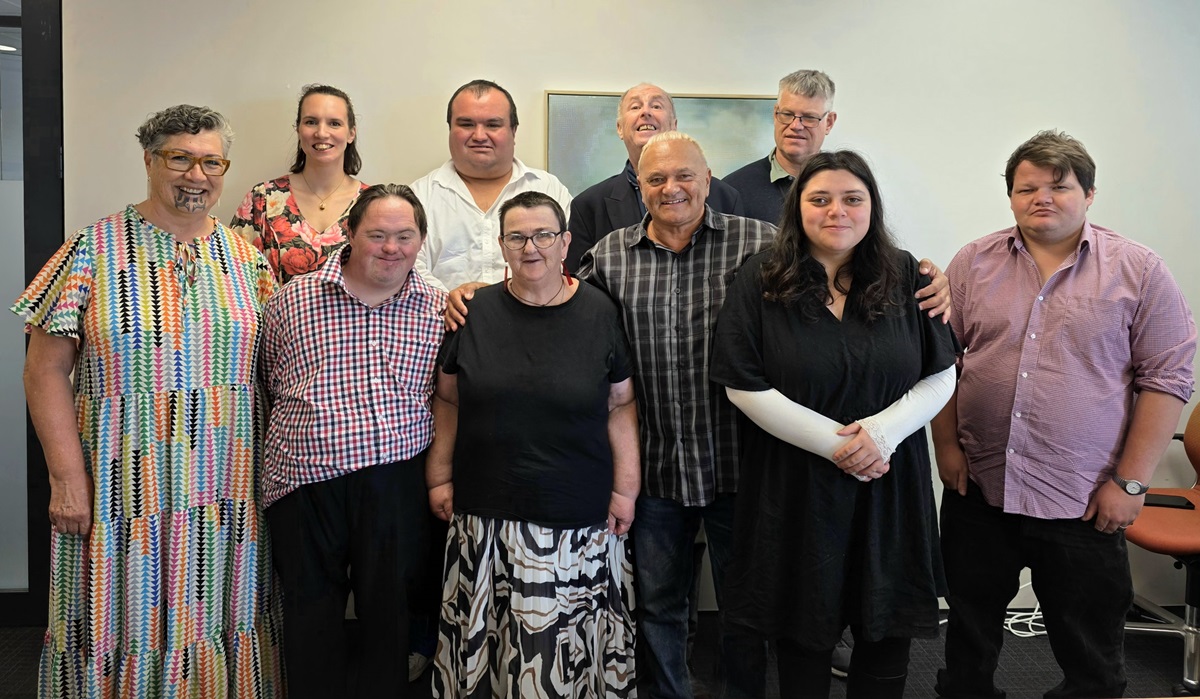
Image: Keri Opai with IHC’s Chief Executive Advisory Group L-R IHC Director of Advocacy Tania Thomas, IHC Inclusion Advisor, Nicolina Newcombe, Neville Pugh, Waata Houia, Diane Pelvin, Hamish Taverner, Keri Opai, David Corner, Alexandra Flutey Rowe, Craig Bellis.

This story was published in Strong Voices. The magazine is posted free to all IHC members.
Download PDF of Strong Voices issue