Categories


Building a future where everyone can thrive
Since joining IHC in February, Chief Executive Andrew Crisp has spent time listening and learning. He has visited and talked to people with intellectual disabilities, their whānau, IHC staff, carers, funders, donors and many others.
Through these conversations he has built a picture of our sector – one that can be inspiring but, at times, sobering.
He has seen people with intellectual disabilities who live the lives they want to, surrounded by whānau, carers and communities that support them.
He has also seen services and homes that are simply not fit-for-purpose, and people whose lives and surroundings fall far short of what they want and deserve.
“I saw that we needed to reset,” says Andrew. “And to make sure IHC continues to honour the legacy of those parents who 76 years ago started a movement to improve the lives of their children.
“The research in our 2023 Data to Dignity report only reinforced this. Intellectually disabled New Zealanders die up to 20 years earlier than the rest of the population, which is just unacceptable. And many other life indicators are bleak.
“To understand the reality of life for people with intellectual disabilities and their whānau was the first step.
“And from there we could build a strategy that would bring real and lasting change for the 50,000 New Zealanders affected.
“To make sure we truly understood the situation, we engaged with people in multiple ways. We held face-to-face and online conversations across the country, did an online survey, shared information in Easy Read formats and had discussions with people with intellectual disabilities and their whānau.
“People told us what mattered most to them, what was working, what wasn’t and what they wanted to see change.”
For many, including long-time IHC member and parent Kay Pearce, being part of the strategy engagement was deeply personal.
“The initial contact to respond to the survey piqued my interest. I was constantly reminded by my grandmother and mother that my voice wouldn’t be heard until I made it happen. It leaves me with a legacy of asking questions – maybe too many sometimes.
“I have a vested interest in the organisation as my son is living in residential care with IDEA, so I felt I had a valuable opportunity to respond as a mother, as someone with a family member in care, as an active member of an Association I care about, and as a past Member Council member, all of which gave me insight into the governance of the organisation.”
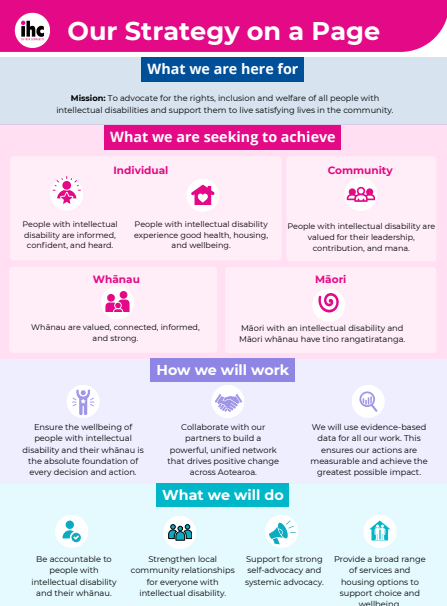
From the feedback, IHC has developed a 10-year strategy, which Andrew Crisp presented to members at the October AGM.
“It sets out our mission, which is unchanged, what we want to achieve, how we’re going to work and what we are going to do. It is simple but not easy.”
Otago Association Chair Eric Robertson reinforces the need for change.
“IHC is well overdue for a renewed focus. I’m excited about the prospect these changes will bring while remaining guarded until we see exactly how it will deliver direct benefits for people with intellectual disabilities.”
“I’m heartened that we’ve got a sound foundation from which we can develop the next level of detail.”
Andrew Crisp acknowledges people want to know what IHC will do next.
“The next step is to develop clear action plans – turning aspirations into action, together. We will work in partnership with people with intellectual disabilities and their whānau, ensuring their voices and experiences continue to guide our work.
For Kay, that promise makes all the difference.
“My voice was heard, and my plea to not leave anyone behind – words I first heard at the 2018 Inclusion International Conference – was listened to. Those words resonated and have become part of the action plan going forward,” she says.
“We also have an assurance from our CE that there will be checks and balances along the way to ensure each step taken is in the right direction.
“I sincerely believe IHC members and cohorts can collaborate to achieve the goals set. Not one part of the organisation has the answer to how to move forward, but we should be able to work together to achieve as the IHC community, being respectful of each other’s boundaries.
“My passion is supporting an organisation that has survived and continually evolves to ensure my son, and others following us, will have the same rights as any other New Zealanders. There’s still some way to go yet.”
With people, whānau, and communities at the heart of the reset, Andrew says the strategy is a deliberate, purposeful and timely shift toward that future.
What we heard
- People appreciated the clear focus on outcomes for people with intellectual disabilities – and the importance of hearing their voices.
- Whānau play a vital role in communication and decision-making, and need to be supported in that role.
- People want IHC to focus more on those who can’t speak for themselves.
- There is a strong call for more transparency about how IHC makes decisions.
- People want to see more choice, control and real opportunities for personal growth, friendships and relationships.
- Many told us the biggest challenges happen at key transition points – early childhood, leaving school and when parents are no longer able to be involved.
- Finding help can be difficult. People said there’s a lack of clear information and too many barriers.
- Keep it simple – make sure the strategy is something everyone can understand and see themselves in.
Caption: IHC's Strategy. A PDF version is available here
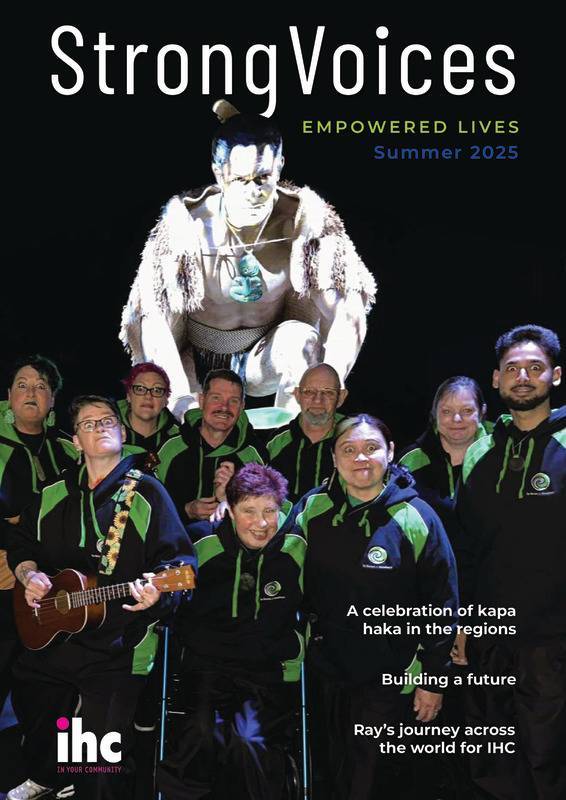
This story was published in Strong Voices. The magazine is posted free to all IHC members.
Download PDF of Strong Voices issue